In Praise of the Noble Art of Music Walter
by Jonathan Swett
 Johann Walter lived through the early and tardily years of the Lutheran Reformation, and every bit the "first cantor of the Lutheran Church," significantly shaped the musical life of the church of that period and the centuries that followed. Much similar Martin Luther, Walter devoted considerable endeavor to developing a proper understanding of the utilize of music in the Christian community and chose a most interesting medium to catechize the true-blue—in 1538 he crafted Lob und Preis der loeblichen Kunst Musica (In Praise of the Noble Fine art of Music), a rhymed didactic verse form of 324 lines which expresses a theology of music based on Reformation insights.
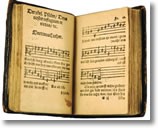
Born in Kahla in central Federal republic of germany in 1496 where he likely attended the Latin school and served equally a choirboy, lilliputian else is known of Walter until he entered the court chapel of Frederick the Wise in 1517 to serve as a bass singer and composer. In 1524—the aforementioned year he became Kapellmeister in Torgau, and with Luther's encouragement and guidance—Walter published his Geystliche gesangk Buchleyn, a drove of 43 pieces for three, four, and five voices arranged according to the church twelvemonth. The vast majority of the pieces were cantus-firmus compositions with the tune in the tenor function and were intended for utilize by church choirs and in the instruction of youth in schools—a sentiment shared by Luther in the preface he provided to the collection. Occasionally, Walter placed the cantus-firmus melody in the upper voice which would become the norm by the end of the 16th century.
One year later, Luther enlisted the assistance of Walter and his mentor, Conrad Rupsch, to set up music for his Deudsche Messe (German language Mass). In a later description of the work, Walter offered high praise of Luther's musical aptitude and regard for the importance of the theological use of music: "And 1 sees, hears, and understands at once how the Holy Spirit has been active not only in the authors who equanimous the Latin hymns and gear up them to music, but in Herr Luther himself, who now has invented well-nigh of the poesy and melody of the High german chants. And it can exist seen from the German Sanctus how he bundled all the notes to the text with the right accent and concent in masterly fashion."1
 Following the death of Elector Frederick the Wise and succession of John the Steadfast in 1525, a period of turn down and uncertainty arose in which Melanchthon and Luther were swift to abet for music and Walter'due south service. In 1526 Melanchthon wrote to John the Steadfast, "Why should the noble fine art of music not remain active now for God's sake, since information technology is used for the service and glory of God."2 The same mean solar day Luther also addressed the new Elector, "The art of music is worthy of being supported by Princes and Lords, much more so than many other endeavors and enterprises for which at that place is non nearly and then much need."3
Walter married Anna Hesse in June of 1526, and following the inevitable disbandment of the Hofkapelle, assumed the position of cantor at the Municipal Latin School in Torgau. He too became director for a group of musical amateur citizens who met together to sing and report music known as the Stadtkantorei. Walter's devotion to the metropolis and schoolhouse choirs served as a model in the region and had a meaning touch on on the development and advancement of music during the Reformation period. In 1548, in the midst of the tumultuous time following Luther'south decease two years prior, Walter accepted the invitation of the new Elector Moritz to organize and straight music for the courtroom chapel in Dresden. After six curt years he returned to Torgau—where his only son, Johann, still resided—and where he would later dice on March 25, 1570.
Aside from Walter'southward compositional output for the liturgical service, other notable works include his widely used Passion settings (a development which culminated in the settings of Johann Sebastian Bach in the early 1700s), an homage-motet based on Psalm 119 for the October three, 1544 dedication of the first church building built by Lutherans (Chapel of the Castle Hartenfels), and a large-scale collection of polyphonic music as a tribute to Luther and based on his "very terminal hymn"—Das christlich Kinderlied D. Martini Lutheri Erhalt uns Herr (1566). The final stanza of the only hymn text of Walter's to appear in Lutheran Service Book, "The Bridegroom Presently Will Call Us," is a plumbing equipment summary of the bang-up influence of the "father of Lutheran church music" on the futurity beyond Walter in this world and the heavenly worship of the Church everlasting.
"In that fair home shall never be silent music'south voice;
With hearts and lips forever we shall in God rejoice,
While angel hosts are raising with saints from not bad to to the lowest degree
A mighty hymn for praising the Giver of the banquet."4
Jonathan A. Swett is Kantor of Our Savior Evangelical Lutheran Church and School, Hartland, MI.
Most data for this article is paraphrased from:
Schalk, Carl. Music in Early Lutheranism. St. Louis: Concordia Academic Press, 2001.
1 Verba des alten Johann Walters in Michael Praetorius' Syntagma musicum I (Wittenberg, 1614/15), 449-53. Quoted from Paul Nettl, Luther on Music (Philadelphia: Muhlenberg, 1948), 75-76.
2 Quoted in Walter E. Buszin, Luther on Music, Pamphlet Serial, no. iii, (ed. Johannes Riedel; St. Paul: Lutheran Society for Worship, Music and the Arts, 1958), eight-9.
iii Ibid., ix.
4 Public domain
0 Response to "In Praise of the Noble Art of Music Walter"
Post a Comment